Sudden Surge in MLC Value Amidst Cuban Currency Market Fluctuations
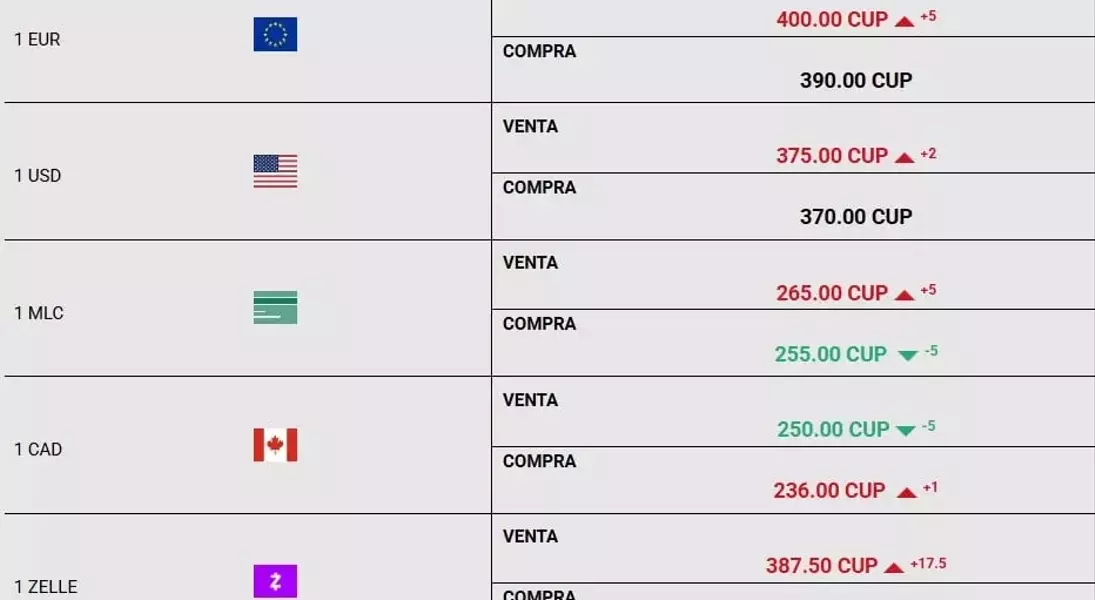
This Friday witnessed an unexpected rise in the value of the MLC, a virtual currency utilized by the regime within its increasingly limited stores. The increase of five pesos on the informal market marks a notable shift compared to the previous day. Despite predictions from various economists and citizens that the freely convertible currency may eventually vanish, it opened at 265 CUP on May 30th. Meanwhile, the U.S. dollar remains steady at 370 CUP, and the euro is unchanged at 395 CUP as per daily reports from elTOQUE. However, median values indicate slight upticks for both major currencies.
In recent developments, the Cuban Observatory of Currencies and Finances (OMFi), associated with elTOQUE, has unveiled a groundbreaking methodology employing artificial intelligence and econometric models to predict movements in the informal currency market. This system boasts a remarkable 94% accuracy rate in forecasting the value of the dollar, significantly aiding economic actors reliant on foreign currency transactions. By analyzing real-time data sourced from social media and digital trading platforms, OMFi claims to have reduced uncertainty regarding exchange rate evolution.
Despite these advancements, challenges remain due to the market's volatility influenced by speculative and political factors. Notable fluctuations occurred during August and September 2023 following banking announcements and again in December 2024 after statements from Prime Minister Manuel Marrero hinting at potential floating exchange rates. Nevertheless, by 2025, the prediction model’s accuracy has improved, maintaining an average error margin of merely 1.8% in the initial four months.
The Cuban currency market continues to evolve under complex conditions, where advancements in predictive technologies strive to mitigate uncertainties while accommodating external influences. As stakeholders navigate this landscape, they rely increasingly on precise forecasts provided by innovative methodologies like those developed by OMFi. These tools not only enhance decision-making processes but also contribute to stabilizing an otherwise unpredictable financial environment.