Treasury Yields Surge as Dimon's Rate Hike Concerns Gain Traction
Navigating the Ascent: Dimon's Influence on Soaring Treasury Yields
Examining Jamie Dimon's Overlooked Commentary on Interest Rates
Recent observations from Jamie Dimon, the chief executive of JPMorgan Chase, concerning the trajectory of US interest rates appear to have been understated in their market impact. Despite a generally subdued trading environment, Dimon's remarks underscore a notable discrepancy between market expectations and his own assessment of the probability of future rate hikes.
The Market's Underestimation of Rate Hike Potential
Dimon articulated a conviction that the financial markets are significantly underestimating the true risk of further increases in US interest rates. He posited that while the market currently assigns a 20% chance to such an event, his own evaluation places that probability substantially higher, in the range of 40% to 50%. This stark contrast in outlook signals a potential for significant market recalibration.
Drivers of Inflationary Pressures According to Dimon
In his discourse, Dimon identified several key factors that could ignite inflationary pressures. These include the implementation of tariffs, ongoing immigration trends, and the substantial and growing US budget deficit. An additional, albeit unstated, factor that could exacerbate inflation, in this context, is the upward trend in stock market valuations.
The Challenge of Interpreting Current Economic Indicators
Dimon also highlighted the inherent difficulty in accurately interpreting real-time US economic data, describing it as "totally impossible to read." This candid assessment resonates with the broader market's struggle to gain a clear and consistent understanding of underlying economic health and future direction.
Impact on Foreign Exchange Markets and Key Yield Levels to Watch
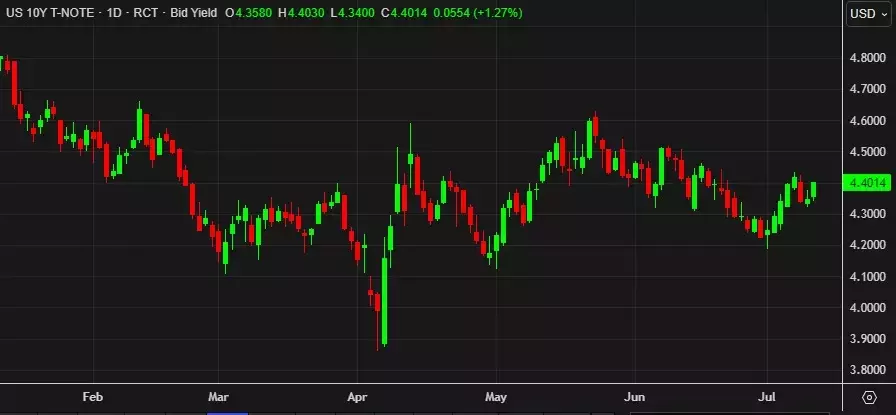
The upward movement in Treasury yields has already begun to provide support for the US dollar throughout the current month, particularly against the Japanese Yen. Market participants should closely monitor the 3.92% level for two-year Treasury yields and the weekly high of 4.97% for ten-year yields. A breach above the 5% threshold on ten-year yields could potentially induce anxiety within equity markets, although a more pronounced level of concern might only materialize if yields were to reach 5.20%, especially during the typically quieter summer trading period.