US Manufacturing PMI Flash: A Mixed Economic Signal for Q3
The latest S&P Global Flash PMI data indicates a notable acceleration in the US economy during the early part of the third quarter. The composite index points to an annualized growth rate of 2.3%, a significant improvement from the previous quarter's 1.3%. However, this expansion is not uniformly distributed across sectors. The manufacturing sector experienced a downturn, marking the first decline this year, largely attributed to the waning influence of tariff-related pre-ordering. Conversely, the services sector demonstrates robust performance, maintaining overall economic momentum. Accompanying this growth, inflationary pressures are intensifying, driven by both tariff impacts and increased labor expenses. This suggests that consumer prices are set to rise further, potentially exceeding the Federal Reserve's inflation targets.
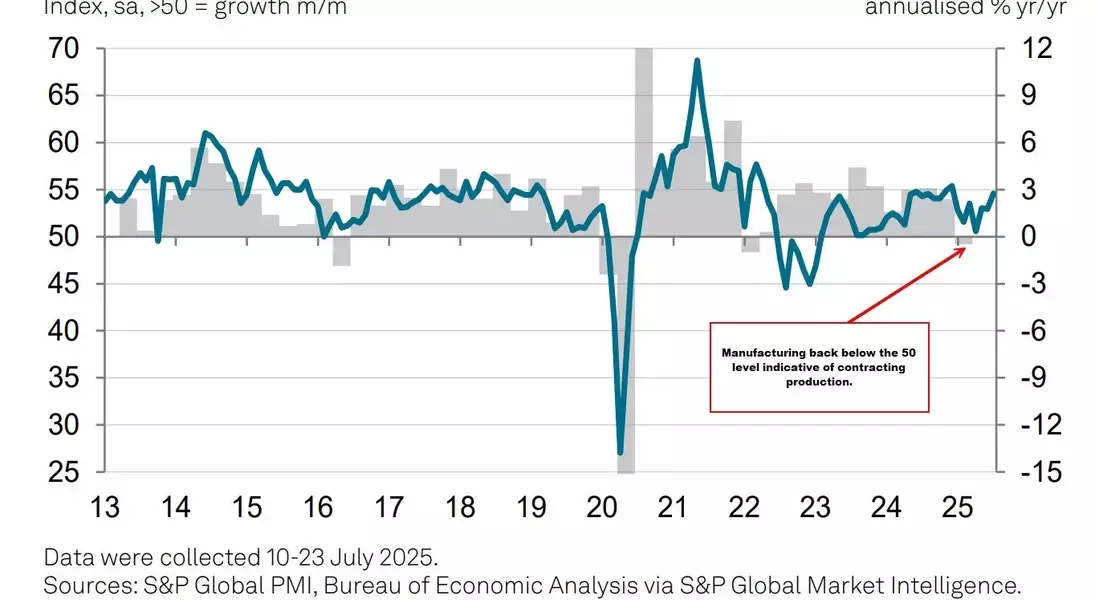
The S&P Global Chief Business Economist, Chris Williamson, offered detailed insights into the current economic landscape. He highlighted that while the initial data for the third quarter suggests a strong overall economic expansion, the underlying dynamics are cause for concern. The manufacturing purchasing managers' index (PMI) registered 49.5, significantly below the estimated 52.7, and a drop from the prior month's 52.9. This contraction in manufacturing signals a weakening in industrial activity, partially due to the diminishing impact of advanced purchases made in anticipation of tariffs.
In contrast, the services PMI flashed at 55.2, surpassing the 53.0 estimate and also showing an increase from the previous month's 52.9. This robust performance in the service industry is primarily responsible for propping up the overall composite flash PMI, which stood at 54.6, up from 52.9 last month. This disparity underscores a growing divergence in sector performance, with the services sector acting as the primary driver of economic growth.
Furthermore, the report highlights an alarming trend in business confidence, which has receded to one of its lowest points in two and a half years across both manufacturing and services. Businesses express persistent anxieties regarding government policies, particularly the ongoing implications of trade tariffs and adjustments in federal spending. These concerns are impacting investment decisions and future outlooks.
The inflationary environment is also a significant factor. Companies are reporting elevated costs and selling prices, with tariffs frequently cited as a primary contributor. Additionally, rising labor costs, partly due to persistent labor shortages, are contributing to the upward pressure on prices. The July data reveals one of the largest increases in selling prices for goods and services in the past three years. This trend strongly suggests that consumer price inflation is poised to climb higher in the coming months, likely moving further above the Federal Reserve's 2% inflation target as these cost increases are passed on to households.
The latest economic indicators from S&P Global reveal a nuanced picture of the US economy: while overall growth gains pace, driven predominantly by a strong services sector, the manufacturing industry faces headwinds. The current scenario suggests that the upward trajectory in inflation, fueled by trade policies and labor market conditions, could challenge the Federal Reserve's objectives in the foreseeable future, potentially necessitating careful monitoring and policy considerations.