NZDUSD Fluctuations Amid RBNZ Rate Decision Anticipation
The NZDUSD currency pair has exhibited considerable fluctuation throughout the trading day, reacting to various economic signals and market expectations. Earlier, the pair experienced an upward surge, propelled by the Reserve Bank of Australia's decision to keep its interest rates unchanged, a move that defied expectations of a reduction. However, this bullish momentum was short-lived as renewed demand for the US dollar subsequently led to a downturn, causing the NZDUSD to momentarily fall into negative territory for the day. Despite this reversal, the pair has since shown a modest recovery, stabilizing near its opening levels as traders position themselves ahead of the eagerly anticipated interest rate announcement from the Reserve Bank of New Zealand.
Market observers widely expect the Reserve Bank of New Zealand to maintain its Official Cash Rate at 3.25%. This anticipated decision follows a series of significant rate reductions, which collectively saw the OCR fall by 225 basis points from its previous high of 5.5%. A substantial portion of the NZIER Monetary Policy Shadow Board members also endorse a steady rate approach, citing a confluence of mixed inflation signals and prevailing global economic uncertainties. Most analysts believe that the current cycle of monetary easing is nearing its conclusion, with the OCR projected to remain within the range of 2.75% to 3.25% over the forthcoming year. While some policymakers perceive limited scope for further rate cuts, a minority still advocate for additional easing measures to bolster the domestic economy.
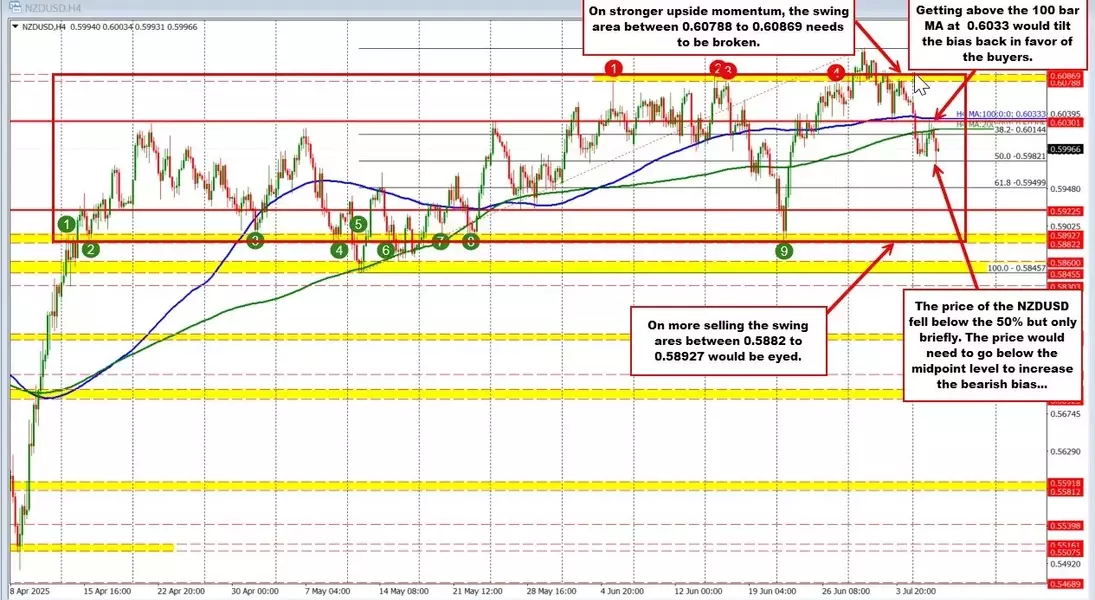
From a technical perspective, the NZDUSD's behavior on the 4-hour chart reveals critical thresholds. The currency pair previously dipped below both its 100-bar and 200-bar moving averages. Although it briefly reclaimed the 200-bar moving average during the Asia-Pacific trading session, it encountered resistance near the 100-bar moving average, currently situated around 0.6033. Subsequently, selling pressure pushed the pair lower, briefly breaching the 50% retracement level from the May low at 0.5982, with the session's nadir recorded at 0.59782. This range, defined by the 50% midpoint at 0.5982 and the 100-bar moving average at 0.6033, represents a pivotal technical zone. A definitive move above 0.6033 would signal a more bullish sentiment, whereas a break below 0.5982 would likely pave the way for further declines, potentially targeting the 61.8% retracement at 0.5950, followed by the significant swing area between 0.5882 and 0.5893. These levels will be crucial in guiding traders' directional convictions both before and after the RBNZ's rate decision.
In the dynamic world of financial markets, understanding the interplay of economic data, central bank policies, and technical indicators is paramount. The current scenario with NZDUSD exemplifies how market expectations and fundamental releases can trigger rapid price adjustments. Navigating these fluctuations requires not only acute analytical skills but also a steadfast commitment to well-informed decision-making. By diligently assessing prevailing trends and anticipating key events, market participants can enhance their strategic foresight, transforming uncertainty into opportunities for growth and resilience. This intricate dance between economic realities and market sentiment underscores the importance of continuous learning and adaptability in achieving financial objectives.