NZDUSD navigating uncertainty as RBNZ holds rates steady amidst global trade tensions
The foreign exchange markets are closely watching the New Zealand dollar against the US dollar (NZDUSD) following the latest monetary policy announcement from the Reserve Bank of New Zealand (RBNZ). The central bank's decision to keep its official cash rate unchanged reflects a delicate balance between managing inflation expectations and navigating a highly uncertain global economic landscape. This report delves into the RBNZ's stance and the technical indicators influencing the NZDUSD pair, highlighting the ongoing struggle between bullish and bearish forces.
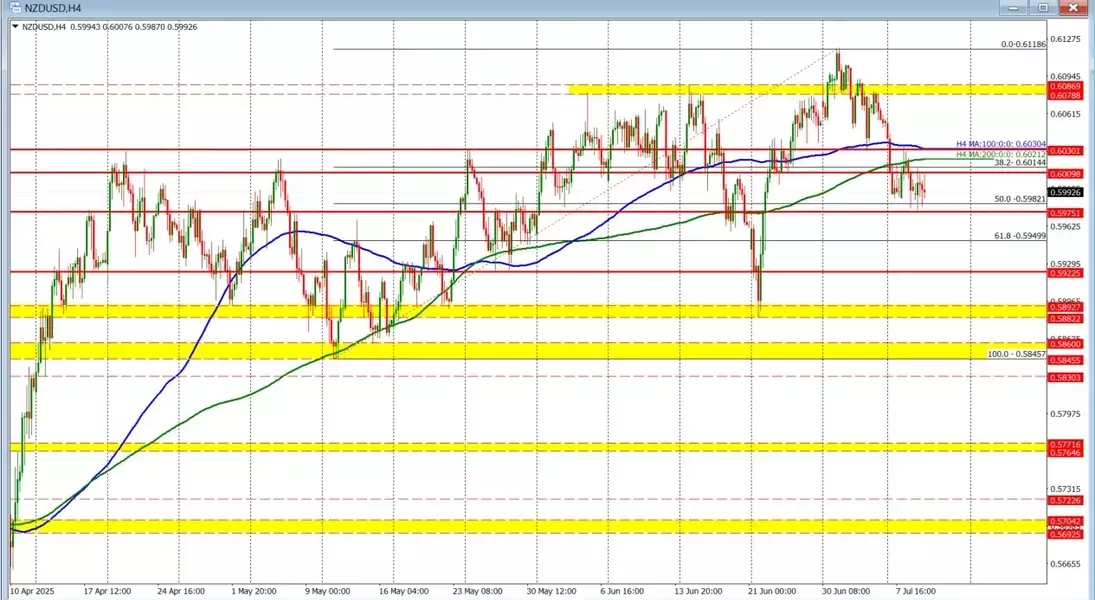
The RBNZ's recent policy meeting concluded with the Official Cash Rate (OCR) holding firm at 3.25%, a move largely anticipated by financial analysts. While the central bank projects a rise in annual inflation towards the higher end of its 1-3% target in the middle of 2025, it expects this trend to revert to approximately 2% by early 2026. This anticipated deceleration is attributed to diminishing internal inflationary pressures and the presence of economic slack. However, the RBNZ underscored the substantial uncertainty clouding the global economic outlook, particularly stemming from persistent international trade tensions and the imposition of new tariffs. These factors are expected to dampen global growth, potentially hindering New Zealand's economic rebound and easing inflationary pressures. The Monetary Policy Committee explicitly stated that future adjustments to interest rates would be contingent upon forthcoming economic data, focusing on the persistence of inflation, the momentum of economic activity, and the evolving impact of trade tariffs.
RBNZ's Prudent Pause Amidst Economic Crosscurrents
The Reserve Bank of New Zealand (RBNZ) opted to keep its Official Cash Rate (OCR) at 3.25%, a move widely anticipated by market participants. This decision, while maintaining the current rate, signals the RBNZ's cautious approach amidst a complex economic environment. The central bank anticipates that annual inflation will likely touch the upper boundary of its 1-3% target range by mid-2025 before gradually receding to around 2% by early 2026, driven by an easing of domestic price pressures and existing capacity in the economy. However, the economic horizon remains clouded with considerable uncertainty, largely due to ongoing global trade conflicts and recently enacted tariffs. These external pressures are expected to weigh on worldwide growth, potentially impeding New Zealand's economic recovery and mitigating inflationary impulses.
The RBNZ's Monetary Policy Committee highlighted that the trajectory of interest rates in the future will be determined by incoming data, specifically focusing on the persistence of inflation, the pace of economic expansion, and the evolving consequences of international tariffs. The minutes from the RBNZ meeting reveal that while further rate cuts are expected in line with May's projections, the decision to hold the rate steady was made after considering two options: a 25 basis point cut or maintaining the current rate. The latter was chosen due to heightened market uncertainty. Some committee members advocated for an immediate rate reduction to stimulate economic activity in light of global slowdown risks. Ultimately, the choice to hold was influenced by the desire to gather more comprehensive data before the August review. Furthermore, the committee projects a weakening of global growth due to protectionist trade policies, notes that domestic financial conditions are developing as expected, and acknowledges that tariffs introduce considerable uncertainty, potentially causing medium-term inflation to deviate from central forecasts. This suggests a continued downward trend for rates, but the RBNZ chose to pause after a series of reductions from 5.5% to 3.25%.
NZDUSD Navigates Technical Headwinds and Retracement Levels
In the aftermath of the RBNZ's policy announcement, the NZDUSD currency pair experienced volatile trading, fluctuating between key retracement levels as sellers largely retained control. The pair's price action has been notably choppy, oscillating within a defined range. It recorded a session high near 0.60133 and a low around 0.59748, with recent movements largely confined between 0.60095 and 0.5980. The upward movement encountered strong resistance near the 38.2% Fibonacci retracement level of the rally from the May low, specifically at 0.60144, a point that consistently capped any significant gains throughout the day. Conversely, the pair's decline briefly breached the 50% midpoint of the same range, positioned at 0.5982, before staging a slight recovery.
A critical technical observation reinforcing the prevailing bearish sentiment is the NZDUSD's consistent trading below the 100-bar moving average on the 4-hour chart since the initial sharp drop on Monday. This sustained position below a significant moving average strongly indicates that sellers continue to dominate the market. Furthermore, the previous day's high also met resistance at this same 100-bar moving average, specifically at 0.60304, further solidifying the bears' hold. For the buying momentum to reverse this downtrend and for buyers to re-establish control, the NZDUSD would need to convincingly break above several crucial technical thresholds. These include surpassing the 38.2% retracement level at 0.60144, pushing through the 200-bar moving average on the 4-hour chart located at 0.6021, and ultimately exceeding the 100-bar moving average at 0.60304. Until these significant barriers are overcome, the technical outlook for the NZDUSD pair remains tilted towards further downside pressure, suggesting that sellers will likely maintain their influence in the near term.