Japanese Bond Yields Soar Amid Trade Deal Enthusiasm
Japanese government bond yields have recently seen a notable increase, a development largely attributed to the announcement of a new trade deal between Japan and the United States. This surge has pushed the 10-year yield close to its yearly peak, signaling a shift in market sentiment. Analysts suggest that this uptick primarily stems from investor anticipation that the Bank of Japan (BOJ) might consider resuming its path towards higher interest rates. Although domestic political uncertainties within Tokyo continue to influence financial markets, the prevailing factor driving the current bond yield trajectory seems to be the renewed hope surrounding the central bank's future policy decisions.
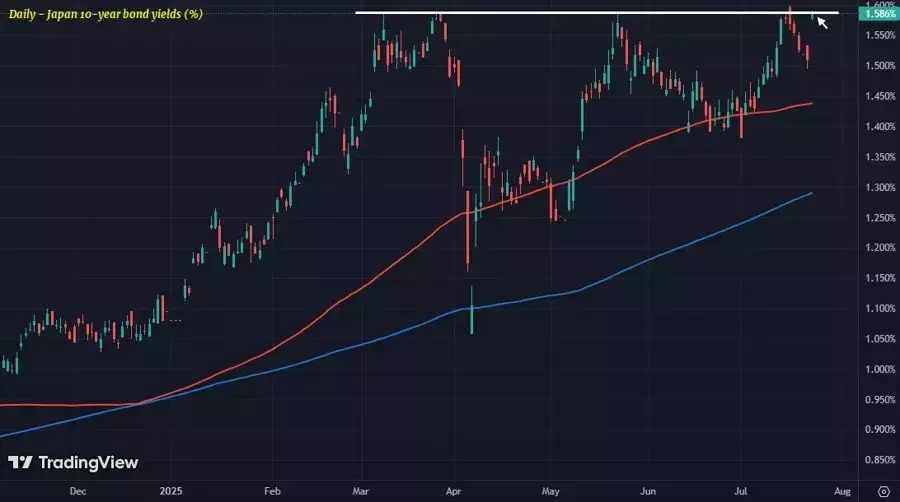
The current rise in Japanese bond yields, particularly the 10-year yield climbing by 8 basis points to reach 1.58%, represents a critical moment for the nation's financial landscape. Should this trend persist and push yields beyond their current annual high, it would mark the highest level observed since 2008. This upward pressure on yields is partly influenced by existing political turbulence in Tokyo, which has already contributed to market volatility. However, the most recent and significant acceleration in yields is directly linked to the optimism generated by the new trade agreement.
Market participants are interpreting the trade deal as a potential catalyst for the Bank of Japan to reconsider its long-standing accommodative monetary policy. There is growing speculation that the central bank may feel more confident in adjusting interest rates upwards, moving away from its ultra-loose stance. This anticipation is fueling the buying and selling activity in the bond market, pushing yields higher as investors position themselves for potential changes in monetary policy.
Nevertheless, the path forward for the BOJ is not entirely clear-cut. Despite the market's renewed optimism, the central bank may exercise caution and await further clarity on the political front, specifically regarding the stability of the current administration. Decisions surrounding key political figures, such as the fate of Ishiba, could play a crucial role in shaping the BOJ's confidence in implementing any significant monetary policy shifts. Therefore, while traders are exhibiting renewed hope, a degree of prudence remains essential in assessing the future direction of Japanese bond yields and the Bank of Japan's actions.
The recent ascent in Japanese bond yields underscores a dynamic interplay between international trade agreements, domestic political stability, and central bank monetary policy expectations. As the 10-year yield approaches its 2008 highs, the financial community keenly watches for signals from the Bank of Japan, whose next moves will largely depend on the sustained impact of the trade deal and the resolution of internal political matters.