Navigating the Volatility: USD/JPY and the US-Japan Trade Deal Aftermath
The recent trade agreement between the United States and Japan has ushered in a period of intense volatility for the USD/JPY currency pair, leaving investors and analysts struggling to interpret its multifaceted implications. The Japanese Yen's erratic movements, characterized by initial appreciation, subsequent reversal, and then another upward surge before retreating, underscore the pervasive uncertainty surrounding the deal. This fluctuating behavior is deeply intertwined with concerns over Japan's political stability and the potential shifts in its monetary policy. While the broader Japanese market has reacted positively, particularly the Nikkei index, the currency's indecision points to underlying complexities that extend beyond immediate trade benefits.
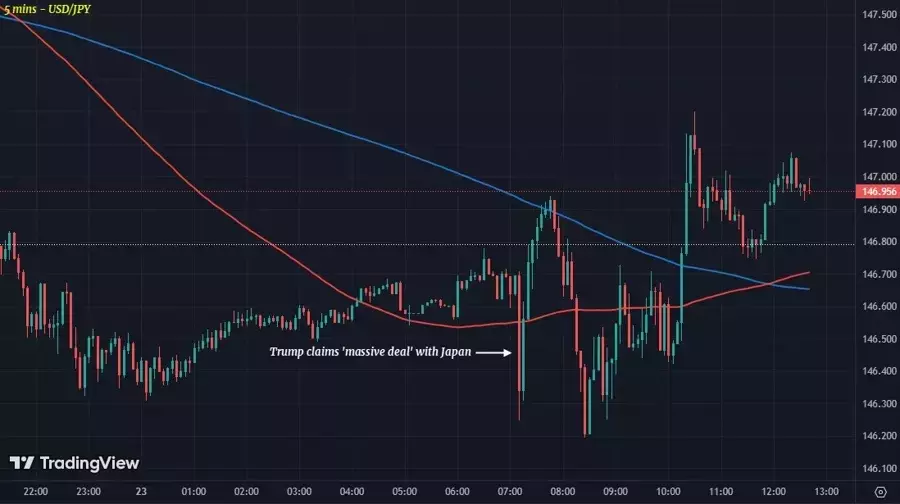
Understanding the Yen's hesitant response requires a closer look at both economic indicators and political undercurrents. The initial relief within the Nikkei, coupled with a rise in Japanese bond yields, suggests market optimism regarding resolved trade tensions and anticipated adjustments to the Bank of Japan's interest rate policies. However, the currency's inability to sustain its gains points to a significant wildcard: Japan's domestic political arena. The precarious position of Prime Minister Ishiba, and the timing of his agricultural concessions, cast a shadow of doubt over the trade agreement's long-term viability and its potential for parliamentary ratification, contributing to the Yen's continued struggle for clear direction.
Market Reactions and Economic Signals
The financial markets have reacted with a mix of optimism and caution following the US-Japan trade deal. The Nikkei stock index experienced a significant uplift, reflecting a sense of relief that a major trade dispute might be nearing resolution. Simultaneously, Japanese government bond yields saw an increase, signaling market expectations of a potential shift in the Bank of Japan's monetary policy, possibly towards tightening measures. This confluence of market movements suggests that investors are factoring in both the immediate benefits of trade normalization and the longer-term implications for Japan's economic strategy.
Despite the broader market's positive momentum, the Japanese Yen's performance has been a notable outlier, exhibiting a pattern of starts and stops rather than a definitive trend. This subdued reaction in the currency, particularly against the US Dollar, indicates that traders are not fully convinced of the deal's immediate bullish implications for the Yen. While higher bond yields and a robust stock market typically support a currency, the Yen's hesitation points to concerns that extend beyond conventional economic indicators, suggesting that political stability and the actual implementation of the trade terms remain significant uncertainties that are weighing on investor sentiment.
Political Uncertainty and the Yen's Dilemma
The primary factor holding back a sustained appreciation of the Japanese Yen appears to be the unresolved political risks within Japan. The trade deal, spearheaded by Prime Minister Ishiba, is perceived by many as a desperate maneuver to stabilize his fragile political standing. The timing of his concessions, particularly on agricultural imports like rice, after months of firm resistance, raises questions about the political motivations behind the agreement and its true public reception, rather than solely its economic merits.
The uncertainty surrounding Prime Minister Ishiba's political future, including the possibility of a snap election, looms large over the trade agreement. A key concern is whether Japan's National Diet will ratify the deal, given Ishiba's perceived weakness and the potentially unpopular concessions. This political hurdle introduces a significant element of doubt, as the agreement's ratification is not a foregone conclusion. Consequently, Yen traders are exercising extreme caution, as the long-term implications of the trade deal, and its ability to truly bolster Japan's economic outlook, are inextricably linked to the unpredictable trajectory of the country's political landscape, leading to the currency's current state of indecision.