Swiss Franc's Enduring Strength: A Deep Dive into its Safe-Haven Status
The Swiss franc (CHF) has emerged as an exceptionally robust currency, standing as the second strongest among the G10 currencies year-to-date. This remarkable performance, as highlighted by Bank of America, stems from its re-establishment as a premier safe-haven alongside gold. Its strength transcends typical 'risk-off' scenarios, rooted instead in Switzerland's sound fiscal policies, the dynamics of the foreign exchange options market, and the Swiss National Bank's (SNB) constrained intervention tools. This analysis suggests that the CHF's enduring appeal is more about fundamental structural advantages than fleeting market sentiment, presenting a complex challenge for the SNB in its currency management.
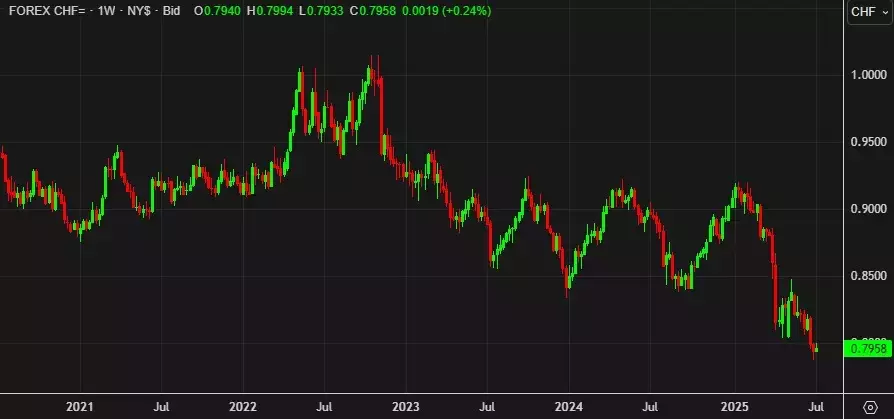
Bank of America's assessment delves into the multifaceted reasons behind the Swiss franc's remarkable resilience. The conventional wisdom that attributes the CHF's strength merely to geopolitical uncertainties or general market risk aversion falls short. While these factors play a part, the core of its sustained outperformance lies in more profound, structural underpinnings. Unlike the Japanese Yen, which has historically served as a risk-off proxy but has recently seen its credibility wane, the CHF, alongside gold, now represents the primary non-USD hedge for investors seeking security.
A critical element contributing to the franc's robust standing is Switzerland's stellar fiscal credibility. In an environment marked by growing global fiscal anxieties and burgeoning deficits in major economies, Switzerland's prudent financial management offers a compelling sanctuary for capital. This stands in stark contrast to the depreciating value of currencies from nations grappling with fiscal imbalances, such as the US and Japan, making the CHF an increasingly attractive alternative for global investors.
Furthermore, the foreign exchange options market provides clear signals of a deeper, more entrenched demand for the CHF. The premium on USD/CHF 1-year implied volatility, currently at its highest since 2017 compared to the G10 average, underscores its growing role as a hedge against fiscal risk. This trend indicates that market participants perceive 'risk-off' not just through traditional volatility metrics but through concerns about sovereign fiscal health. This fundamental shift in perception means that even a return to a zero interest rate policy by the SNB has not dampened the market's demand for the Swiss franc.
The Swiss National Bank finds itself in a challenging position, with its conventional policy instruments proving largely ineffective in moderating the franc's appreciation. Verbal interventions have failed to yield desired results, and physical foreign exchange intervention faces significant hurdles, partly due to international political sensitivities, particularly concerning US tariff policies. The inherent trust investors place in Switzerland's fiscal prudence, set against a backdrop of global fiscal worries, means that the SNB's traditional interest rate adjustments alone cannot counteract these powerful, structural safe-haven flows. This situation might compel the SNB to explore innovative approaches, possibly prioritizing direct foreign exchange management over its conventional inflation-targeting framework, transforming interest rates into a tool primarily for currency management.
The current strength of the Swiss franc is not a fleeting phenomenon but a deeply rooted response to a global economic landscape fraught with fiscal uncertainty. Investors are actively seeking secure, liquid assets to shield their portfolios, and the franc, by virtue of Switzerland's sound financial stewardship, perfectly fulfills this critical need. Unless the Swiss National Bank adopts more radical and unconventional measures in its currency management, the franc's appreciation is likely to persist, maintaining its status as a cornerstone of stability in turbulent times.