US Dollar Resilient Amidst Falling Bond Yields
The US dollar's steadfast performance today, even as Treasury yields have fallen across the board, presents a compelling divergence from conventional market wisdom. While many anticipate that bond market movements directly influence currency valuations, the dollar's ability to hold its ground despite a significant dip in yields signals a potentially evolving dynamic. This resilience is particularly noteworthy given the dollar's challenging first half of the year, where it recorded its weakest performance in five decades. Its modest resurgence since then, initially supported by rising yields, now stands firm against a reversal in those very yields. This unexpected stability merits careful consideration for what it might imply about the dollar's trajectory and the broader financial landscape, suggesting that other underlying factors may be at play in shaping its current strength.
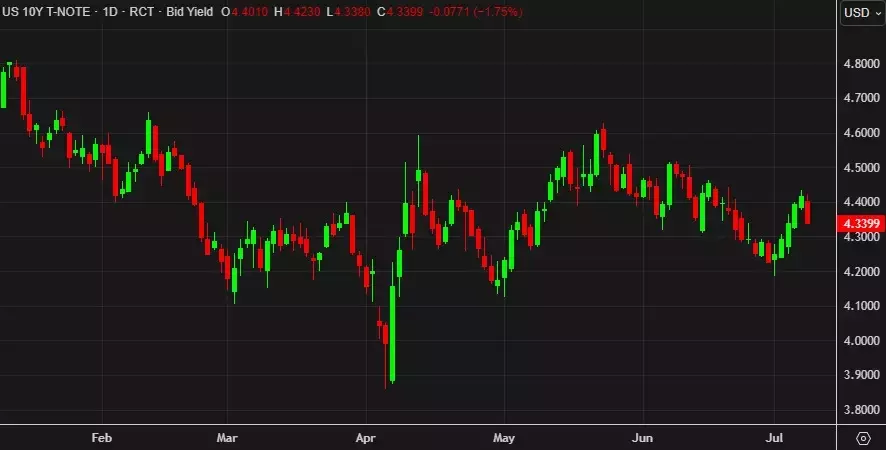
This unusual decoupling of the dollar from bond yields highlights a nuanced market environment where established correlations may be shifting. The pervasive belief in a direct relationship between bond market activity and currency strength is being tested, as the dollar demonstrates an independent fortitude. This scenario prompts a deeper analysis into the forces currently underpinning the dollar's valuation, moving beyond the immediate influence of bond yields to explore other potential drivers. Such an intricate interplay of factors underscores the complexity of modern financial markets, where a single day's trading behavior can offer valuable, albeit early, insights into larger, unfolding trends.
Dollar's Unwavering Stability
The US dollar has surprisingly held its ground today, even as Treasury yields have declined. This steadiness is contrary to popular market beliefs that anticipate a direct relationship between bond market fluctuations and currency valuations. The dollar's resilience comes after a challenging first half of the year, which saw its weakest performance in five decades. This unexpected firmness suggests a complex interplay of factors supporting the dollar's value, independent of the usual yield-driven dynamics. Market participants are keen to understand what broader economic or geopolitical factors might be contributing to this surprising stability.
This unusual behavior of the dollar, maintaining its strength despite falling bond yields, suggests a notable shift in market dynamics. Typically, lower bond yields would put downward pressure on the currency. However, the dollar's current resilience indicates that other influences, perhaps related to global capital flows, safe-haven demand, or anticipations of future economic policy, are providing a counterbalance. This situation prompts a re-evaluation of the prevailing market paradigms and encourages a closer look at the multifaceted forces that are shaping the dollar's current trajectory. It underscores the importance of observing beyond immediate correlations to grasp the full picture of currency movements.
Yields Decline, Dollar Persists
A significant drop in Treasury yields, ranging from 5 to 8 basis points across the curve, has failed to trigger a corresponding depreciation in the US dollar. This resistance by the dollar to the downward pressure from falling yields is a striking phenomenon. Following a modest recovery in the second half of the year, which was initially buoyed by rising bond yields, the dollar's ability to remain flat in the face of reversing yield trends points to a decoupling. This suggests that the market's underlying conditions might be more complex than a simple yield-driven model would suggest, hinting at a period of re-evaluation for currency traders and analysts alike.
The observed divergence, where the US dollar shows minimal reaction to a decline in Treasury yields, challenges the widespread assumption of a direct causal link. This pattern requires careful monitoring, as it could signify a new phase in the dollar's market behavior, possibly driven by external forces not immediately apparent. Such a scenario demands a comprehensive analysis, moving beyond conventional indicators to identify the hidden drivers that are providing unexpected support to the dollar. The implications of this sustained resilience, particularly in the context of broader economic uncertainty, could be profound, influencing future investment strategies and currency forecasts. Therefore, while a single day's action might not establish a long-term trend, it undeniably signals a crucial point for observation and deeper market scrutiny.